Memory kernel non-additivity in the generalized quantum master equation for a system coupled to multiple heat baths #486
Authors
Callie Wilson, Xiaohan Dan, Victor S. Batista, Eitan Geva
Abstract
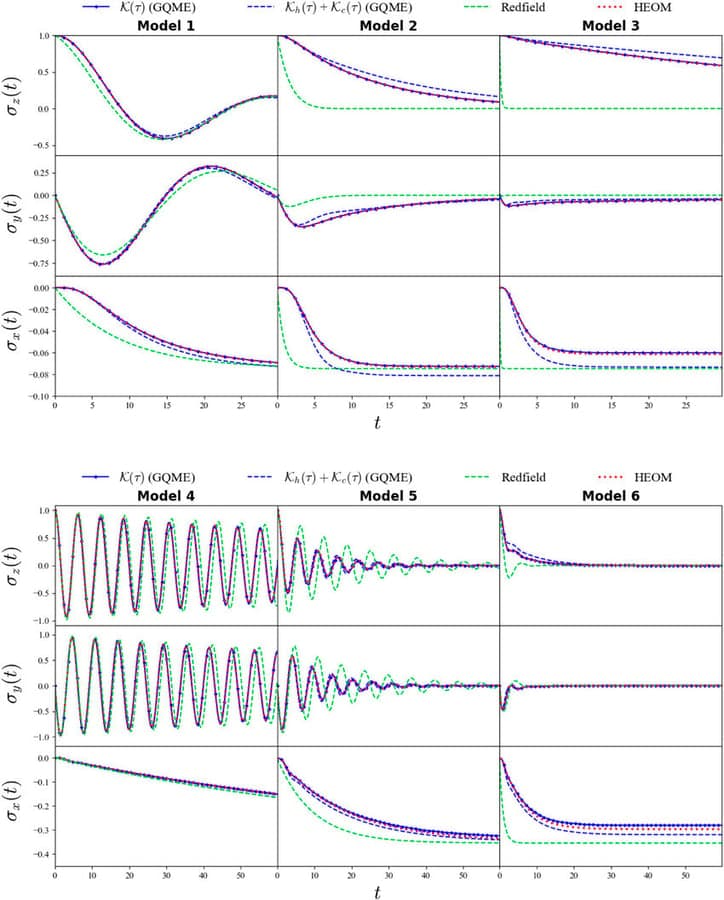
The generalized quantum master equation provides an exact equation of motion for the reduced density operator of a quantum system coupled to one or more baths, with all bath-induced effects encoded in a memory kernel superoperator. In this paper, we investigate whether the memory kernel for a system coupled simultaneously to multiple independent baths can be written as a sum of memory kernels associated with the corresponding single-bath problems. We show that such additivity holds in the weak system–bath coupling limit, where the second-order memory kernel separates into independent bath contributions. Beyond this limit, however, the baths become dynamically correlated through their mutual coupling to the system, and the exact multi-bath memory kernel is no longer equal to the sum of exact single-bath memory kernels. We demonstrate this non-additivity for a two-level system linearly coupled to hot and cold harmonic baths, using the hierarchical equations of motion method to construct the memory kernels. The results show that non-additivity increases with system–bath coupling strength and is process-dependent: coherence damping remains comparatively well described by an additive kernel, whereas population–coherence and coherence–coherence transfer exhibit pronounced non-additive behavior. These findings clarify the limitations of additive multi-bath descriptions and highlight the ambiguity of decomposing heat flow into independent bath-resolved contributions beyond weak system–bath coupling.