Mechanism of Tyrosine-Driven Deprotonation in Photosystem II Revealed by Multiscale Simulations #466
Authors
Jinchan Liu, Ke R. Yang, Julianne S. Lampert, William H. Armstrong, Gary W. Brudvig, Victor S. Batista
Abstract
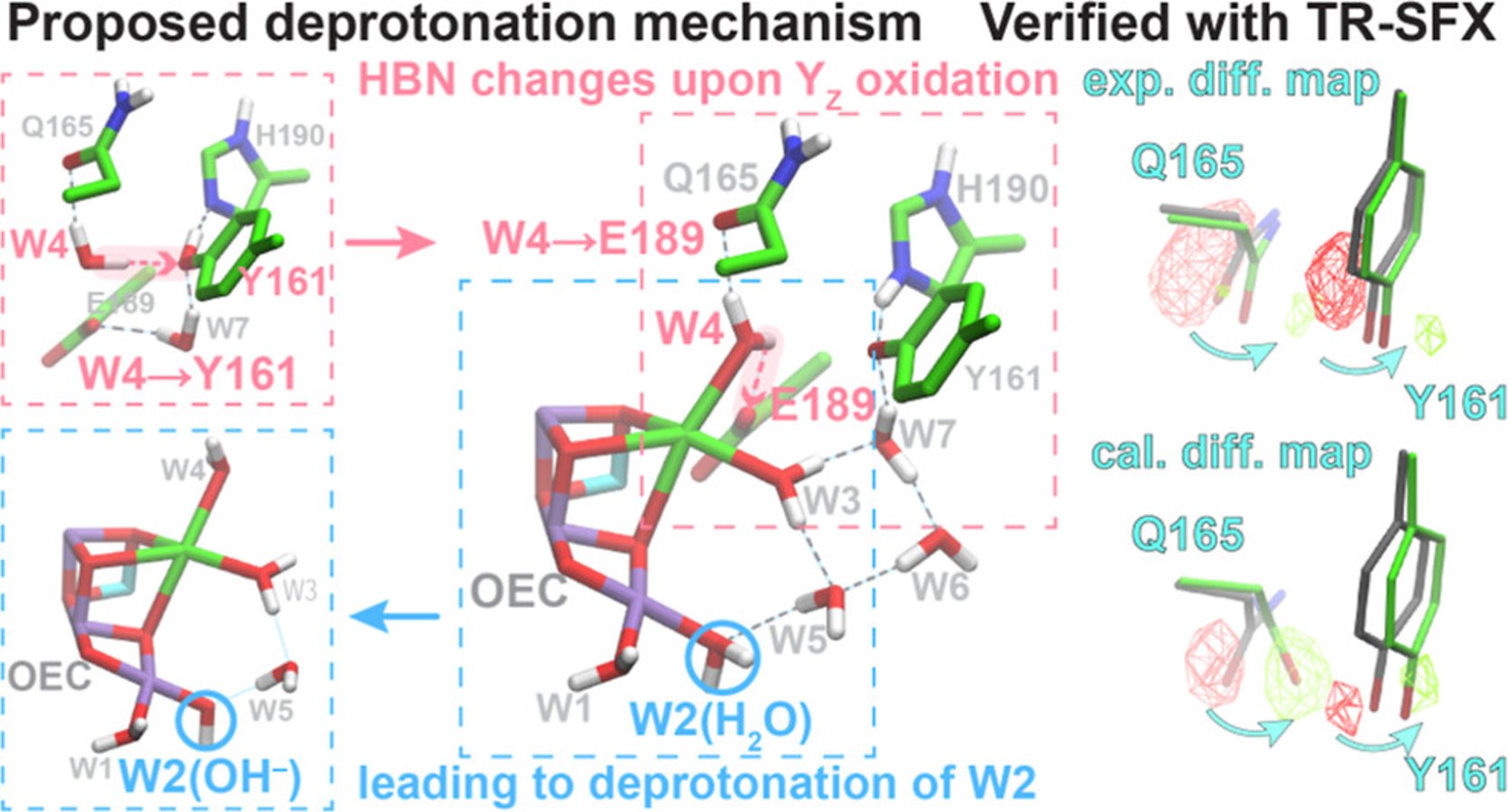
Photosystem II (PSII) drives light-induced water oxidation via stepwise redox transitions of its oxygen-evolving complex (OEC), a Mn4Ca cluster advancing through five intermediate S-states (S0–S4). The S2 → S3 transition involves a redox event in which a Mn ion donates an electron to the redox-active tyrosine YZ, coupled to deprotonation of an OEC-bound water ligand─yet the underlying coupling mechanism remains unresolved. Time-resolved serial femtosecond crystallography (TR-SFX) has revealed transient electron density shifts near the redox-active tyrosine YZ, interpreted as sequential oxidation and reduction, with reduction initiating ∼1 μs after excitation and substantially progressed by 30 μs. However, this interpretation conflicts with kinetics from photothermal beam deflection (PBD), time-resolved X-ray absorption spectroscopy (TR-XAS), and electron paramagnetic resonance (EPR), which place electron transfer at 190–400 μs and proton transfer around 30 μs. Here, we reconcile these discrepancies using quantum mechanics/molecular mechanics (QM/MM) and molecular dynamics (MD) simulations. We show that oxidation of P680 and YZ breaks the symmetry of the nearby hydrogen bonds involving water molecule W4, displacing YZ and replicating the TR-SFX features of YZ and Q165 observed at 1 μs. This local perturbation propagates through a hydrogen-bond network, transmitting the electrostatic signal from YZ to the E65-E312 dyad and triggering redox-coupled deprotonation via the Cl1 channel. By 30 μs, the hydrogen-bond symmetry is restored through deprotonation of W2 (or alternatively W1), reproducing the disappearance of TR-SFX density differences around YZ and Q165 without requiring YZ reduction. Our proposed mechanism also gives molecular insights into the O6* density, assigning it to water reorganization rather than a discrete Ca-bound hydroxide species. Our results reveal a detailed atomistic mechanism linking YZ oxidation to long-range proton release and suggest a functional role for the nearby Cl– ion in proton transfer. More broadly, this study underscores the importance of hydrogen-bond dynamics in mediating redox-driven proton transport and demonstrates how integrative simulations can resolve mechanistic ambiguities.